Francisco Cabán and The Ascension of the Lark

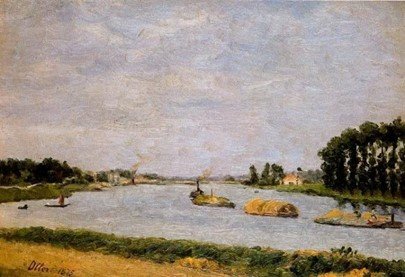
Boats on the Seine - Francisco Oller 1875

Francisco Cabán and The rise of the lark

He rises and begins to round,
He drops the silver chain of sound,
Of many links without a break,
In chirrup, whistle, slur and shake.

For singing till his heaven fills,
'Tis love of earth that he instills,
And ever winging up and up,
Our valley is its golden cup
And he the wine which overflows
to lift us with him as he goes.

Till lost on his aerial rings
In light, and then the fancy sings.

Extract

It rises and starts to spin,
Drop the silver chain of sound,
of many links and without cracks,
in warbles, whistles, portamentos and trills.

She fills her paradise with singing,
It is the love of the earth that infuses,|
and always flying higher and higher,
Our valley is your golden cup
and she is the wine that overflows
lifting us up in his path.

Until it gets lost in its aerial rings
in the light, and then the imagination sings.

Translation of Irene Serrahima Violant

These verses belong to the poem The Lark Ascending (The Ascending of the Lark) by Victorian writer George Meredith (1828-1909). Although his work may not resonate outside of certain specialist circles, the poem was immortalised by the composer Ralph Vaughan Williams (1872-1958) in his work of the same name for violin and orchestra. In her biography of her husband (1964), Ursula Vaughan Williams wrote that he had no programmatic intention, but rather took the poem as his inspiration, managing in his creation to make the violin become both the song of the bird and a sound representation of its flight.

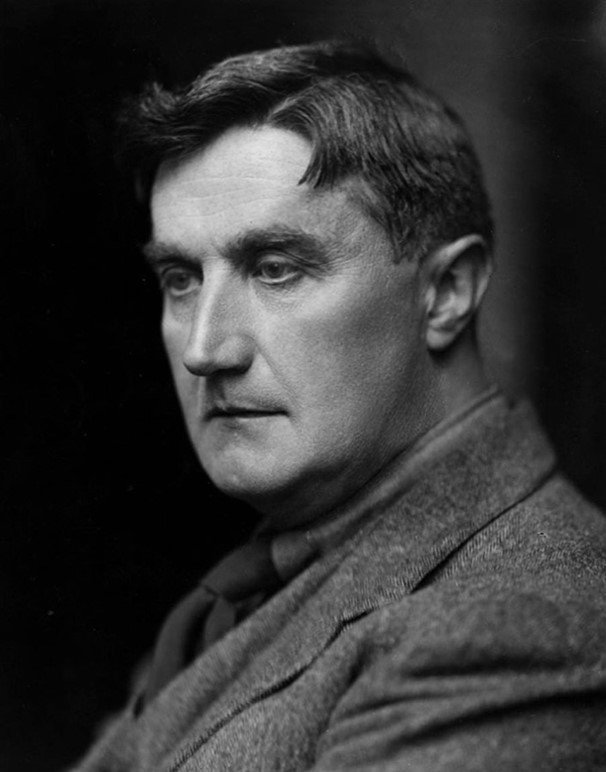
Ralph Vaughan Williams
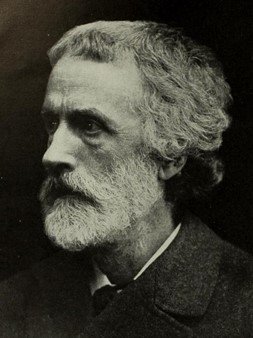
George Meredith

This coming November 23, at the Pablo Casals Symphony Hall, Francisco Cabán will perform this popular work with the Puerto Rico Symphony Orchestra (OSPR) under the direction of its associate director, Rafael Enrique Irizarry. This is not the first time that Cabán, who has been a member of the OSPR since 1992, has performed as a soloist with the orchestra. He has previously performed works such as the Concerto No. 1 by D. Shostakovich and the Concerto No. 2 Karol Szymanowski. “Playing as a soloist with the Symphony is always exciting, not only for the honor it represents as a musician, but also because it means continuing the Puerto Rican tradition of string players. I received that legacy from my teachers and it is beautiful to keep it alive by passing it on to my disciples, some of whom are already members of the orchestra.” About this particular occasion, Cabán adds: “This concert will be very special, since it is the first time that the orchestra performs this beautiful romance.

A graduate of the Conservatory of Music of Puerto Rico (CMPR), Francisco Cabán did postgraduate studies at Temple University in Philadelphia (2000) and completed his doctorate in violin performance at the University of Texas-Austin (2003). Upon returning to Puerto Rico, in addition to resuming his position as a musician in the orchestra, he was appointed professor of violin and chamber music at the CMPR. Throughout his twenty-one years as a professor, Cabán has also been an influence on the artistic culture of the institution. In addition to his passion and commitment to pedagogical practice, he founded the CMPR Violin Festival (2007) and the String Festival (2016), through which internationally renowned figures such as Guillermo Figueroa, Federico Agostini, Francesco Manara, José Francisco del Castillo, Sergiu Schwartz, Nancy Zhou, the Harlem Quartet, among others, were able to be part of the musical growth of instrumentalists inside and outside the institution. The festivals were also vehicles for disseminating the repertoire for string orchestra, from the baroque A. Corelli to the contemporary Arvo Pärt and Alberto Rodríguez. Together with Prof. Diana Figueroa (piano) and Dr. Luis Miguel Rojas (cello), Cabán is a founding member of the Sanromá Trio (the CMPR's ensemble in residence), which this year premiered the Sanromá Trio with the OSPR. Triple concert by Puerto Rican Raymond Torres-Santos.   

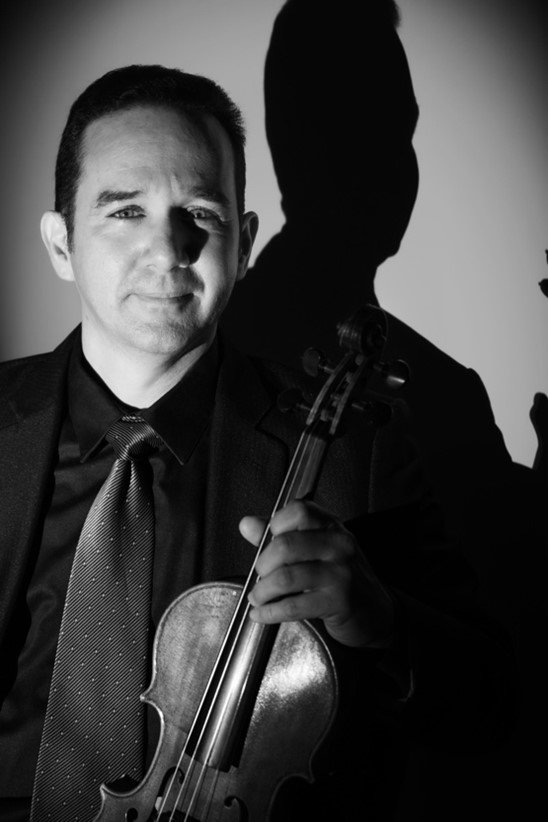
Francisco Cabán (Photo by Elisa Torres)
CMPR String Festival (2024)

Outside of Puerto Rico, Cabán has been invited as a teacher to international festivals such as the Clazz Music Festival (Italy), FOOSA (California), Killington Music Festival (Vermont), Latin American Violin Academy (Mérida, Venezuela) and the Violin Festival of the National Conservatory of Peru (Lima). It was by chance when he was teaching at FOOSA that he had a reencounter with Vaughan Williams’ work. “I knew the piece,” he says, “but I had never played it. At that Festival I had a student who was studying it, so I took the opportunity to see it in some detail. For various reasons, both technical and aesthetic, I thought I could program it in one of my concerts, although I was not sure when and under what circumstances. That was several years ago, so when they wrote me to play it with the OSPR this season everything fell into place.”

Vaughan-Williams is considered one of the most influential English composers of the first half of the 20th century, in part for serving as a bridge between a nineteenth-century German aesthetic and one firmly anchored in English folklore, with some flashes of modernity. Harmonically, The Lark Ascending The piece oscillates between tonality and modality (especially the Dorian and Aeolian modes). In the melody, especially in the initial violin cadenza, pentatonic sonorities stand out. In formal terms, the piece presents a composite ternary structure, meaning that each of the three main sections is in turn composed of several sections. In addition to the thematic and metrical relationships that link the three main parts, musicologist Christopher Mark comments that there is an interesting relationship between the free and fanciful part of the solo violin and the folklore of the orchestral sections, an interaction between heaven and earth, between the ethereal and the human. “It is a wonderful piece that makes me feel in harmony with nature,” Cabán comments. “One day early I decided to take a walk in the park alone. When I arrived, there was an almost deathly silence, but little by little, in crescendo, the sound of the wind rustling the branches of the trees began to make its way in counterpoint to the birdsong. It was at that moment that I understood how I was to interpret the chirps, twitters, whistles and the flapping of the birds' wings that George Meredith describes in the poem.”

Although little mentioned, Vaughan Williams began composing The Lark Ascending at a time of total uncertainty: the outbreak of the First World War. He sketched the first version of the work in 1914, while on holiday in Margate, a coastal town east of London. At that time, England had joined the Allied side and, although the town's port was not a shipping point, the preparations of the British Royal Navy could be observed from the coast. According to his own account, Vaughan Williams thought up and wrote down the melody for the work while walking along the cliff in the town, which is why he was briefly stopped by a young recruit who thought he was collecting military information. Shortly afterwards, Vaughan Williams temporarily abandoned composition and enlisted in the British Armed Forces, with whom he served until the Armistice of 1918. The Lark Ascending It was one of the first works that he revised and orchestrated after returning to composition in 1919. The premiere of the version for violin and piano took place in December 1920 at the Public Hall in Shirehampton and the premiere of the version for violin and orchestra in June 1921 at the Queen's Hall in London. On both occasions the soloist was Marie Hall, to whom Vaughan Williams dedicated the piece. The orchestra that performed the premiere was made up of professional musicians who, like Vaughan Williams himself, had served in the war. Taking this into account, and through a nostalgic pastoral evocation, the work could be understood as a song of hope in the face of the desolation and destruction that forever marked the lives of millions and that would be repeated again, with greater force, two decades later. A little more than a hundred years after the premiere of this work, the sound image of the Rise of the Lark As a symbol of hope in the face of so much anguish, it remains relevant. A little over a hundred years after the premiere of this work, we continue to ask ourselves: will we one day be able to at least imagine a different world?


Dr. Noel Torres Rivera

en_USEnglish